


Clytia hemisphaerica Jellyfish

Not Made of Jelly
Jellyfish are fascinating marine creatures known for their graceful and mesmerizing movements in the water. Belonging to the phylum Cnidaria, these gelatinous animals come in various shapes, sizes, and colors. One distinctive feature of jellyfish is their umbrella-shaped bell, which pulsates to move through the sea water. Here is the hydrozoan jellyfish Clytia hemisphaerica, which many experimental tools and genomic resources are now available.
Paracentrotus lividus

crunching around
Sea urchins, as echinoderms, develop two separate nervous systems during their life cycle: a larval one (later lost) and an adult one, which includes five radial nerve cords, a circumoral nerve ring, peripheral nerves, and a mysterious basiepithelial plexus whose connections remain unclear. Here is the Paracentrotus lividus, with genomic resources available here.
Botryllus schlosseri
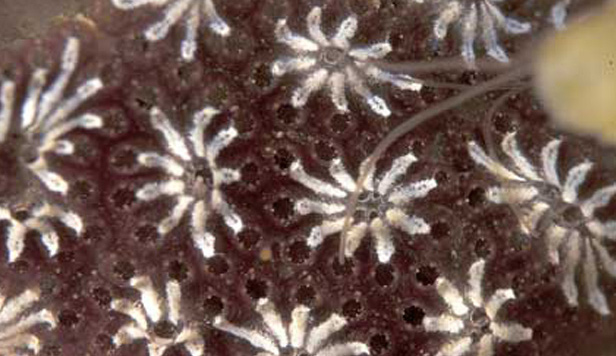
animal flowers....
Botryllus schlosseri, a colonial ascidian, is a powerful model in developmental biology and genomics for studying stem cell biology, regeneration, and allorecognition. Its transparent, rapidly developing colonies allow live imaging of morphogenesis and asexual reproduction via blastogenesis, where new individuals arise from stem cell niches. Genomically, its compact genome (~580 Mb) and close relation to vertebrates provide insights into chordate evolution and gene regulatory networks. Botryllus is unique for its natural chimera formation and immune tolerance, making it ideal for exploring tissue compatibility, aging, and whole-body regeneration.
Amphioxus : Branchiostoma

Sandworm dive in dune....
Amphioxus is among the most basal chordate : it is a cephalochordate leaving in coastal sands. Because of its key evolutionary position and slow rate of evolution that permits learning about the chordate ancestor. It exhibits the typical body plan of a chordate, possessing both a central nervous system and a peripheral nervous system. Molecular data indicate that its central nervous system is similar to that of vertebrates, organized into three sections: anterior, middle, and posterior. Access to genomic data here: