
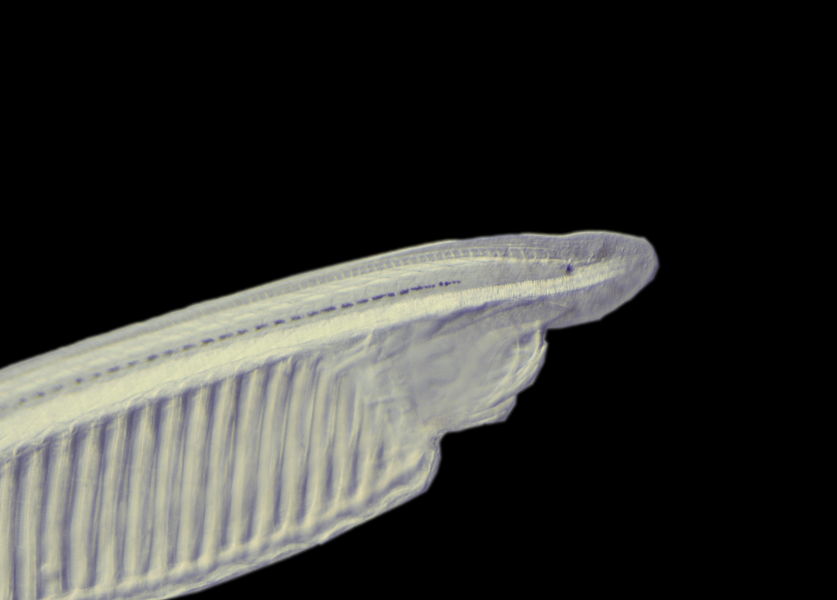
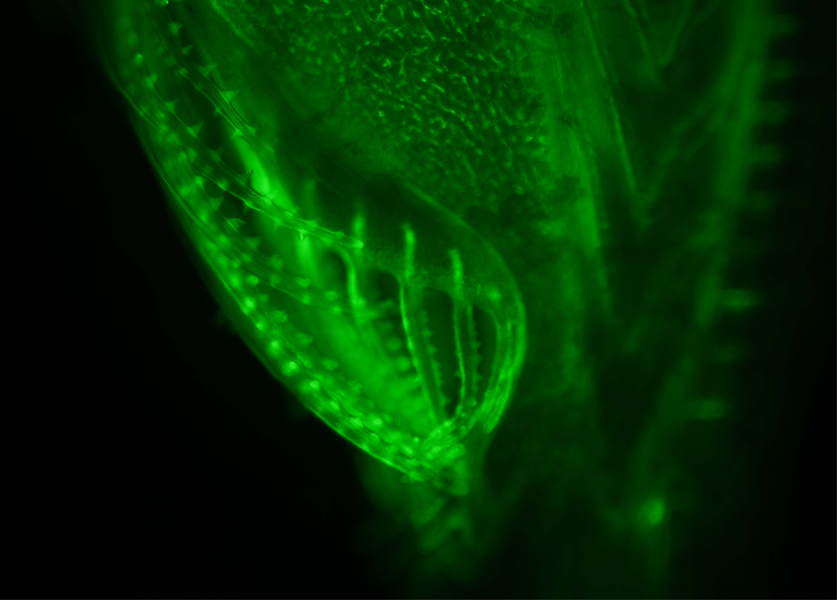
Branchiostoma lanceolatum

Overview
Full NameBranchiostoma lanceolatum
GenusBranchiostoma
Specieslanceolatum
Common NameAmphioxus
AbbreviationB. lanceolatum
Interest

The phylogenetic position of amphioxus, together with its relatively simple and evolutionarily conserved morphology and genome structure, has led to its use as a model for studies of vertebrate evolution. In particular, recent development of technical approaches, as well as access to the complete amphioxus genome sequence, for the Mediterranean amphioxus, Branchiostoma lanceolatum has provided the community with tools with which to study the invertebrate-chordate to vertebrate transition (Bertrand & Escriva, 2011).

Location:

Mediterranean Sea and North-East Atlantic

Attractive features
  • Controlled spawning induction
  • Transparent embryos
  • Micromanipulation techniques available allowing functional approaches in classical embryology and developmental biology
Contributions

Studies with different amphioxus species have helped answer questions about the evolution of the chordate genome, and particularly the evolution of the Hox cluster structure and cis-regulatory elements, the evolution of the control of axial patterning in chordates, and the appearance of vertebrate-specific structures such as the head.

Tools
  • Assembled and annotated genome sequence (550 MB) and many transcriptome resources soon publically available
  • Epigenomic resources including Chip-seq, ATAC-seq, Methylome, CAGE-seq, and 4C for a panel of transcription factors are available for several developmental stages
Drawbacks

Due to a short spawning period (May-July), in vivo experiments are restricted to a short period only. Their life cycle is also relatively long, about 2 years to reach adulthood, and no knockdown techniques are available (no morpholinos, RNAi or siRNA).

Selected references
  • Bertrand S. & Escriva H. (2011) Evolutionary crossroads in developmental biology: amphioxus. Development 138: 4819-30
Transcript Browser
The following browser provides a quick view for new visitors. Use the searching mechanism to find specific features.
NameUnique NameType
BlTCONS00062973BlTCONS00062973transcript
BlTCONS00062974BlTCONS00062974transcript
BlTCONS00062975BlTCONS00062975transcript
BlTCONS00062976BlTCONS00062976transcript
BlTCONS00062977BlTCONS00062977transcript
BlTCONS00062978BlTCONS00062978transcript
BlTCONS00062979BlTCONS00062979transcript
BlTCONS00062980BlTCONS00062980mRNA
BlTCONS00062981BlTCONS00062981mRNA
BlTCONS00062982BlTCONS00062982mRNA
BlTCONS00062983BlTCONS00062983mRNA
BlTCONS00062984BlTCONS00062984transcript
BlTCONS00062985BlTCONS00062985mRNA
BlTCONS00062986BlTCONS00062986mRNA
BlTCONS00062987BlTCONS00062987mRNA
BlTCONS00062988BlTCONS00062988mRNA
BlTCONS00062989BlTCONS00062989mRNA
BlTCONS00062990BlTCONS00062990mRNA
BlTCONS00062991BlTCONS00062991transcript
BlTCONS00062992BlTCONS00062992transcript
BlTCONS00062993BlTCONS00062993transcript
BlTCONS00062994BlTCONS00062994transcript
BlTCONS00062995BlTCONS00062995mRNA
BlTCONS00062996BlTCONS00062996mRNA
BlTCONS00062997BlTCONS00062997transcript

Pages